

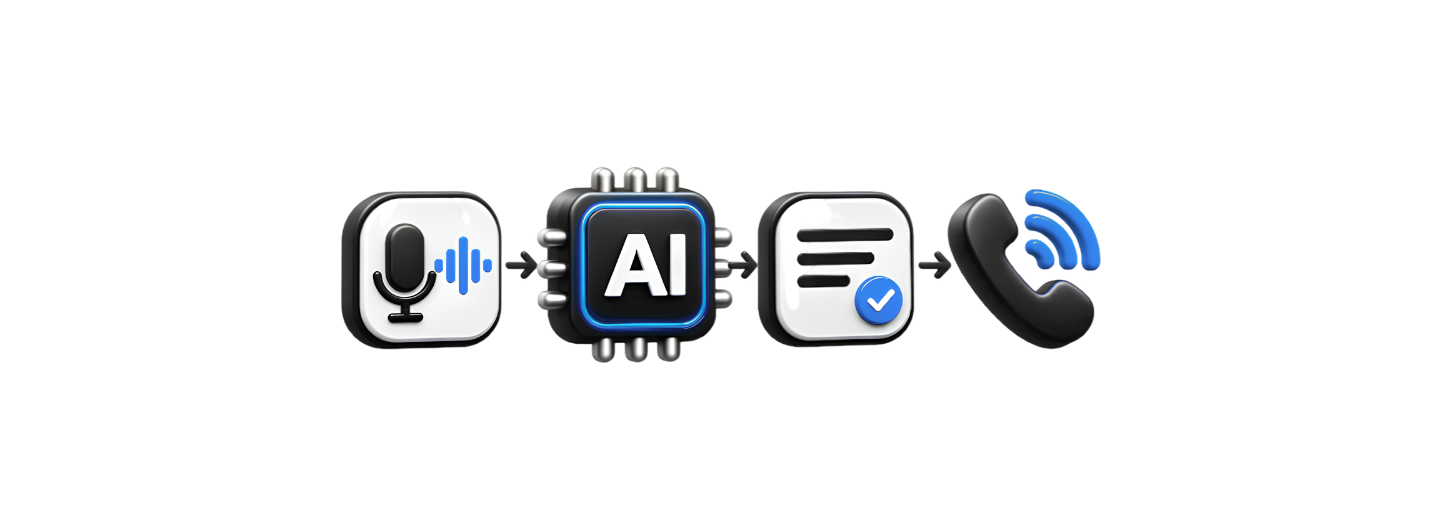
Voice AI allows businesses to communicate with customers through automated phone conversations. It can listen to people, understand their questions and respond using a computer-generated voice. Businesses use AI phone calls for lead qualification, admissions outreach, appointment reminders, payment follow-ups and customer re-engagement.
But how voice AI works behind the scenes is more than simply generating a voice. A typical AI calling system combines speech recognition, language processing and voice generation to manage conversations. It can also use business information, scripts and configured instructions to provide relevant answers.
HOW DOES VOICE AI WORK?
Many Voice AI systems use three common technologies:
- Automatic Speech Recognition (ASR): Converts spoken words into text so the system can process them.
- Large Language Model (LLM): Helps the AI understand customer requests and prepare relevant responses.
- Text-to-Speech (TTS): Converts written responses into spoken audio.
These technologies are commonly used together, but not every Voice AI system follows exactly the same architecture. Some platforms use direct speech-to-speech models or different combinations of technologies.
For example, when a customer asks about course fees, the AI processes the question, understands the customer's intent and prepares an answer using the business's configured information and instructions.
The basic process looks like this:
HOW DOES AN AI PHONE CALL WORK STEP BY STEP?
1. Call Initiation
The process begins when an AI calling system connects with a customer. Depending on the platform, it may support:
- Inbound Calls: Customers call a business and the AI answers.
- Outbound Calls: The AI automatically contacts customers for reminders, enquiries or follow-ups.
For example, an education company may use outbound AI phone calls to contact students who have submitted admission enquiries. Inbound calling availability depends on the platform.
2. AI Speech Recognition
Once the call connects, the AI listens to the customer. A common technology used here is Automatic Speech Recognition (ASR), which converts spoken language into text.
For example:
Customer: “I want to know more about your courses.”
Recognised text: “I want to know more about your courses.”
This speech to text AI process helps the system understand the customer's words. AI speech recognition accuracy depends on audio quality, language support and background noise.
3. Understanding Customer Intent
After recognising the words, the AI identifies what the customer wants.
For example, “What is the price?” indicates a pricing enquiry, while “When is my appointment?” indicates a request for appointment details.
The AI considers the current question, previous conversation and configured business instructions to understand the request.
4. Preparing and Speaking the Response
The AI prepares an answer using available business knowledge, frequently asked questions, scripts, policies and configured instructions. Some platforms can also retrieve information from connected business systems.
For example:
Customer: “Can you tell me about your courses?”
AI: “Certainly! We offer several professional courses. Are you interested in online or classroom programmes?”
The response is converted into audio using text to speech AI. This process is also known as AI voice synthesis.
UNDERSTANDING THE AI VOICE AGENT CALL FLOW
The AI voice agent call flow describes the different stages involved in handling a phone conversation.
| Stage | What Happens |
|---|---|
| Call Initiation | The AI connects with the customer. |
| Listening | Speech recognition processes the customer's words. |
| Understanding | The AI identifies the customer's requirement. |
| Response Generation | It prepares an answer using business information and instructions. |
| Speaking | The response is converted into spoken audio. |
| Call Management | The system manages pauses and interruptions where supported. |
| Post-Call Analysis | The system may generate summaries and call records. |
HOW DOES VOICE AI HANDLE PAUSES AND INTERRUPTIONS?
Natural conversations include pauses, questions and interruptions. Depending on the platform and configuration, an AI voice agent may support:
- Pause Detection: Identifies when a customer has finished speaking.
- Barge-In: Allows a customer to interrupt the AI while it is speaking.
- AI Voice Agent Turn Taking: Manages when the customer speaks and when the AI responds.
Some systems also support an AI voice agent handoff, where conversation context moves between specialised AI agents or workflows. For example, an enquiry workflow may pass relevant customer information to a separate appointment-booking workflow. Availability depends on the platform.
These features help make conversations smoother, but their availability and performance vary across systems.
WHAT IS VOICE AI LATENCY?
Voice AI latency is the delay between a customer finishing a question and the AI responding. The AI voice agent response time can be affected by speech recognition, response generation, voice generation, network delays and external data lookups.
Businesses can improve response time by:
- Using streaming technology to process audio in smaller parts.
- Optimising access to business information.
- Selecting suitable speech and language models.
- Reducing unnecessary processing steps.
- Monitoring delays at different stages of the conversation.
The goal is to make responses quick, relevant and natural.
WHAT HAPPENS AFTER AN AI PHONE CALL ENDS?
Many platforms support AI post call analysis, which helps businesses understand the outcome of completed conversations.
Common outputs include:
- Call Transcripts: Written records of the conversation.
- AI Call Summary: A short explanation of the discussion and customer requirements.
- Call Outcomes: Information about whether a customer was interested, declined or requested a follow-up.
- Customer Updates: Relevant information sent to connected CRM or business systems, where supported.
For example, an AI call summary might state that a student is interested in an MBA programme and requested another call on Friday.
This helps sales teams manage follow-ups without manually reviewing every conversation.
PRACTICAL BUSINESS APPLICATIONS OF AI CALLING
Businesses can use AI calling systems for several everyday activities:
- Lead Qualification: Understand potential customers' requirements and identify promising leads.
- Outbound Follow-Ups: Contact customers who have requested information or shown interest.
- Admissions Outreach: Contact prospective students and answer common admission-related questions.
- Payment Reminders: Remind customers about pending payments and due dates.
- Appointment Reminders: Contact customers about upcoming appointments.
- Customer Re-Engagement: Reach out to previous customers or inactive leads.
These applications help businesses manage repetitive conversations and maintain consistent customer communication.
HOW CALLIENCE HELPS BUSINESSES WITH AI CALLING
Callience focuses on AI-powered voice calling to help businesses automate routine communication. Its use cases include lead qualification, outbound follow-ups, admissions outreach, payment reminders, appointment reminders and customer re-engagement.
These workflows can help businesses reduce repetitive calling work, maintain consistent follow-ups and give teams more time to focus on other important tasks.
CONCLUSION
Understanding how voice AI works involves looking at the complete conversation process, not just the generated voice. Common systems use speech recognition, language models and voice generation to listen, understand and respond to customers.
Features such as interruption handling, response-time optimisation and post-call analysis make AI phone calls useful for different business activities. From lead qualification to customer re-engagement, Voice AI offers businesses more ways to manage routine communication.